How to Identify Buying Tails and Selling Tails in Market Profile
Tails are among the clearest footprints the market leaves in the profile. They show where one side was so aggressive that price only paused briefly – and was rejected immediately.
What is a tail?
A tail (also called an extreme or excess) is a run of single prints at the top or bottom of a profile – price levels that traded in only one TPO period.
- Buying tail: single prints at the bottom. Price dipped briefly, buyers responded immediately and decisively. The zone acts as support.
- Selling tail: single prints at the top. Sellers rejected higher prices. The zone acts as resistance.
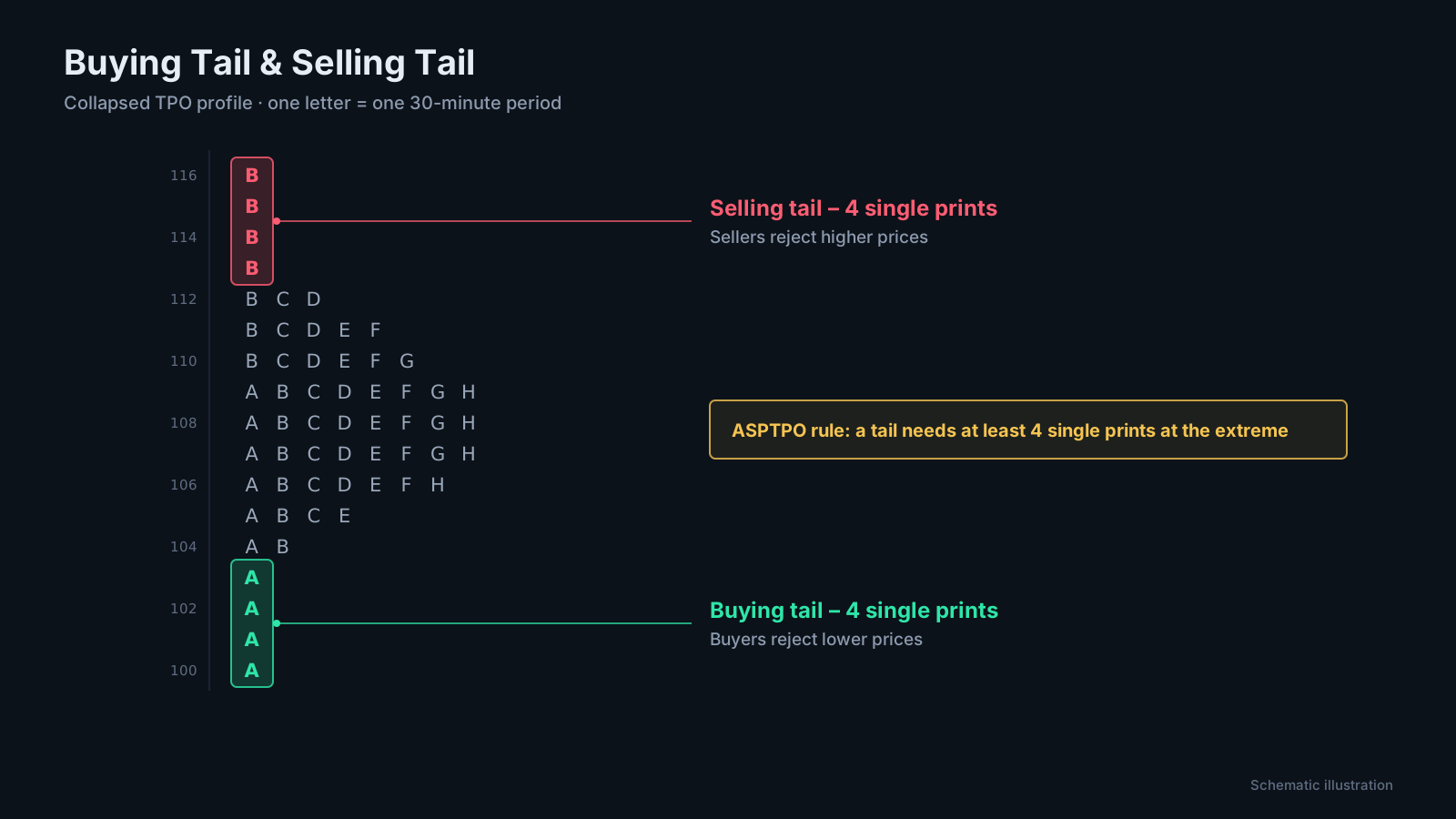 📷 Buying tail (bottom, green) and selling tail (top, red) – 4 single prints each at the extreme
When is a tail significant?
Opinions differ here. Our rule in ASPTPO: a tail requires at least 4 single-print letters at the extreme. One or two lone letters happen constantly through noise and are not reliable. A single letter at the extreme is something else entirely – a poor high or poor low.
When does a tail end?
A tail stays active as a zone until a close through the zone occurs. A wick into it is not enough – the market has to actually accept the zone. That's why tails from previous sessions often stay relevant for days, especially when price trends in one direction and never touches the old zones.
How to trade tails
- Wait for the first return. The first touch of a fresh tail has the highest hit rate.
- Look for order-flow confirmation. Absorption or a delta reversal at the zone are good triggers.
- Stop beyond the extreme. A close through the extreme invalidates the idea.
ASPTPO detects buying and selling tails automatically, colour-codes them and carries them across multiple sessions – without you having to split the profile.