Poor High, Poor Low and Ledge: Spotting Unfinished Auctions
Not every high or low is equal. Some extremes are cleanly finished; others look like the market simply stopped mid-auction. These unfinished auctions are exactly what price tends to revisit later.
Poor high and poor low
A poor high is a high with only a single letter – there is no tail. The market was not decisively rejected at the top, it just ran out of steam. The poor low is the mirror image.
Interpretation: the auction is incomplete. Poor highs and lows are frequently "repaired" later – revisited and traded through.
Ledge
A ledge is a step in the profile: two or more consecutive periods end at exactly the same price. This can be at the top or bottom of the profile – or inside it, where a distribution ends abruptly.
- From 2 periods we call it a ledge.
- From 3 periods the signal is very strong.
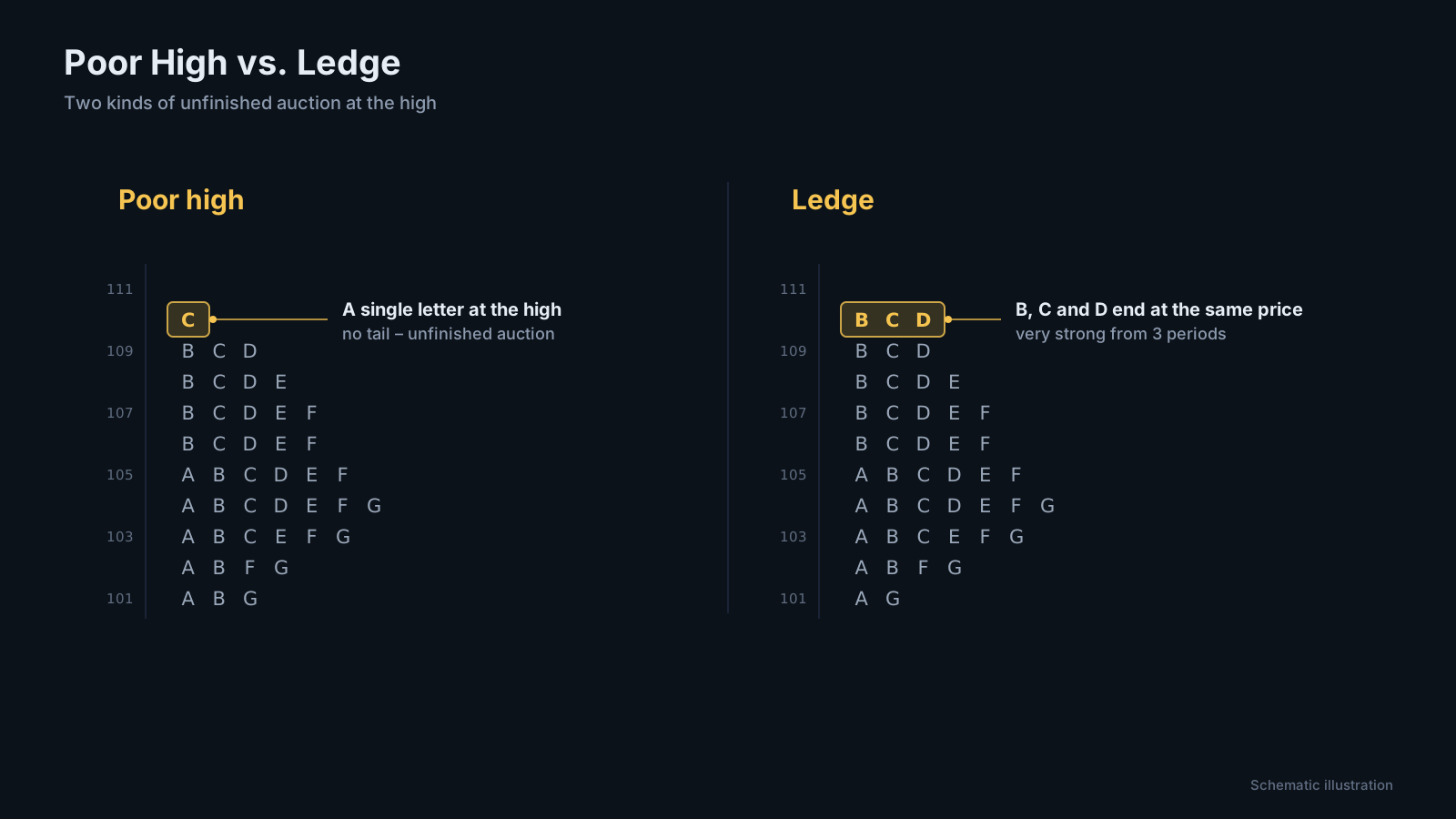 📷 Left: poor high (a single letter at the high), right: ledge (three periods ending at the same price)
Which one matters more?
In our experience a ledge is more significant than a poor high or poor low. A single letter can be coincidence; when the market stops at the same price in several consecutive periods, there is very likely a large participant sitting there.
Trading application
Both structures act as magnets: they are targets for moves in their direction and, on a return, zones where you expect a reaction. Their role depends on context – where are the POC, value area and the tails of recent days?
ASPTPO marks poor highs/lows and ledges automatically, including inside the profile, and colour-codes them separately from tails.